The problem
Many Ukrainians have moved to Bulgaria or plan to, work with Bulgarian colleagues or simply travel there. Bulgarian looks easy because so many words feel familiar. That is exactly the trap: similar words often mean something else, there are no cases, the article sticks to the end of the word, and you cannot guess the stress from the spelling. On top of that, learning materials usually assume you study through English or Russian.
We wanted a course that:
- explains everything in the learner’s native language and builds on the similarity between the languages instead of ignoring it;
- takes a few minutes a day and goes from the first Cyrillic letter to level B1;
- lets you hear every word, sentence and dialogue;
- brings back exactly the words you get wrong.
Bulgarian Lessons is our own product. We designed the methodology and the courses, built the mobile app, the backend and the infrastructure, and we run it after launch.
The solution
What the app does
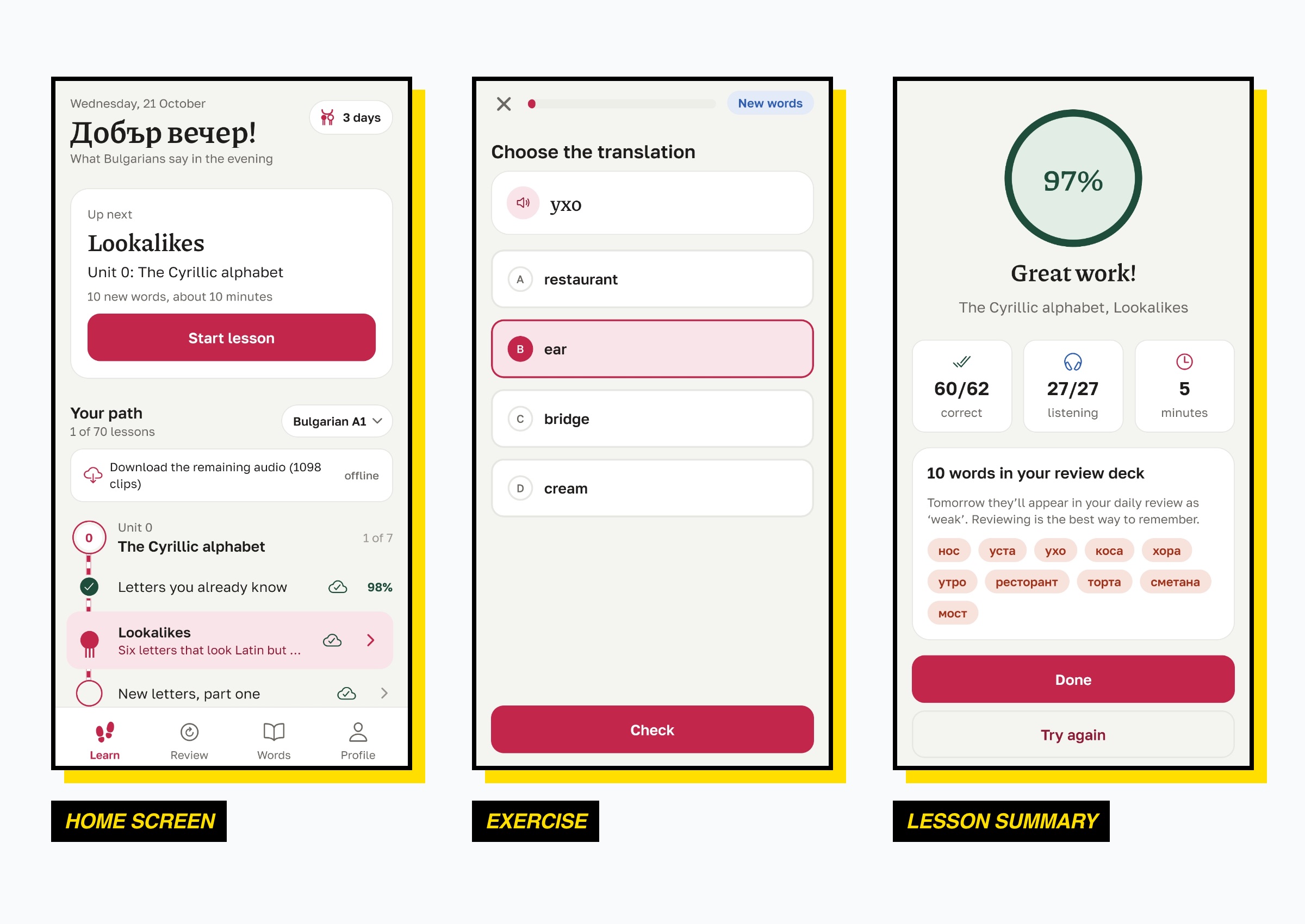
- Three levels: A1, A2 and B1. 186 lessons for Ukrainian speakers, from the alphabet and greetings to dialogues and reading and listening texts at B1.
- Lessons that take a few minutes. New words appear on cards, then come the exercises: choose an answer, recognise a word by ear, type it, build a sentence from parts, match pairs, go through a dialogue. Answers are checked instantly.
- Every word, sentence and dialogue is voiced. 4,149 audio clips generated with a male and a female ElevenLabs voice.
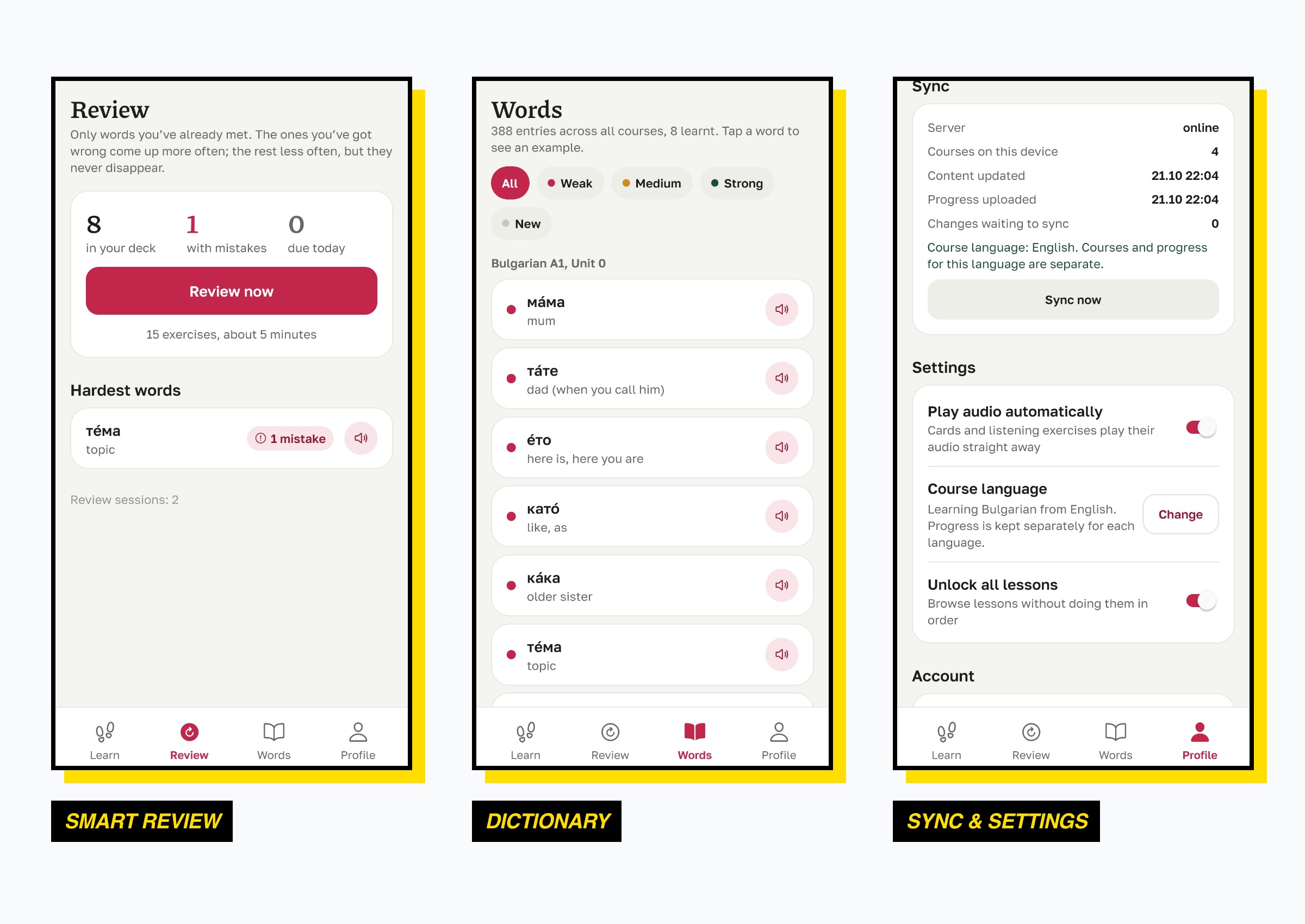
- Review that remembers mistakes. Only words you have already met: the ones you got wrong come up more often, the ones you know less often, but they never disappear. The hardest words have their own screen.
- A summary after each lesson: accuracy, listening score and the words added to the review deck.
- A dictionary across all courses, filtered by strength: weak, medium, strong, new.
- False friends. Separate notes on words that look like the learner’s own language but mean something else.
- Offline. Audio for a lesson or a whole course can be downloaded in advance. If a clip is missing, listening exercises switch to reading ones automatically and the lesson keeps going.
- Three learner languages: Ukrainian, English and German. Each language has its own courses and progress, and the interface follows the learner’s language.
How it works
- Methodology. Microlessons that follow “learn → practise → review”. Grammar is introduced inductively: examples first, then the rule. A word always comes in context and with audio, and the course points out differences from the learner’s language explicitly.
- Lesson engine. A lesson is not a hard-coded list of screens: the engine assembles it from content units (cards → mini-checks → practice → dialogue → check), and builds each review session from the learner’s mistake history. More than ten exercise types.
- Content separate from the app. Courses live in their own repository and go through validation. A script generates the audio and caches it by a “voice + text” hash, so a rerun only voices what is new. The app reads courses from the server catalogue: three German courses reached users without a new build.
- Go backend: guest sign-in on first launch, an account to move progress to a new phone, progress sync through an event queue that delivers changes once the connection is back, the course catalogue and audio delivery.
- Monetisation. All courses are free with one new lesson a day and unlimited reviews. Pro removes the limit: monthly and yearly subscriptions with a 7-day free trial, or a one-off lifetime purchase. Payments go through Google Play Billing and RevenueCat, the server enforces the limit, and a webhook keeps the Pro status up to date.
- Version control. The server knows the minimum and the latest app version: it shows a “New version available” banner or blocks an outdated build. Nothing is blocked offline.
- Privacy. Users can delete their account right in the app, together with their data on the server and in the payment service.
- Infrastructure as code. Terraform creates the server on Hetzner Cloud, Caddy provides HTTPS, and the services (Postgres, Redis, S3-compatible audio storage) run in Docker Compose.
Results
| 7 | courses for three learner languages: Ukrainian (A1–B1), English (A1), German (A1–B1) |
| 446 | lessons |
| 4,149 | voiced audio clips |
- The Ukrainian edition is live on Google Play: Bulgarian Lessons.
- The English and German editions are in testing.
- An automated run through all 7 courses and 446 lessons passes without a single problem.
- Product website with plans and privacy policy: bglessons.com.
We bring the same things to client apps: offline mode, server sync, in-app payments, content updates without a new release and version control.
Tech stack
React Native · Expo · TypeScript · Zustand · Go · PostgreSQL · Redis · S3 (RustFS) · ElevenLabs · RevenueCat · Google Play Billing · Docker · Terraform · Hetzner Cloud · Caddy
Need a mobile app with offline mode, payments and your own backend? Discuss your project